
The conversation has shifted from whether agents will transform work to how organizations redesign around them.
(based on NLW, The AI Daily Brief Podcast, 30.06.2026)
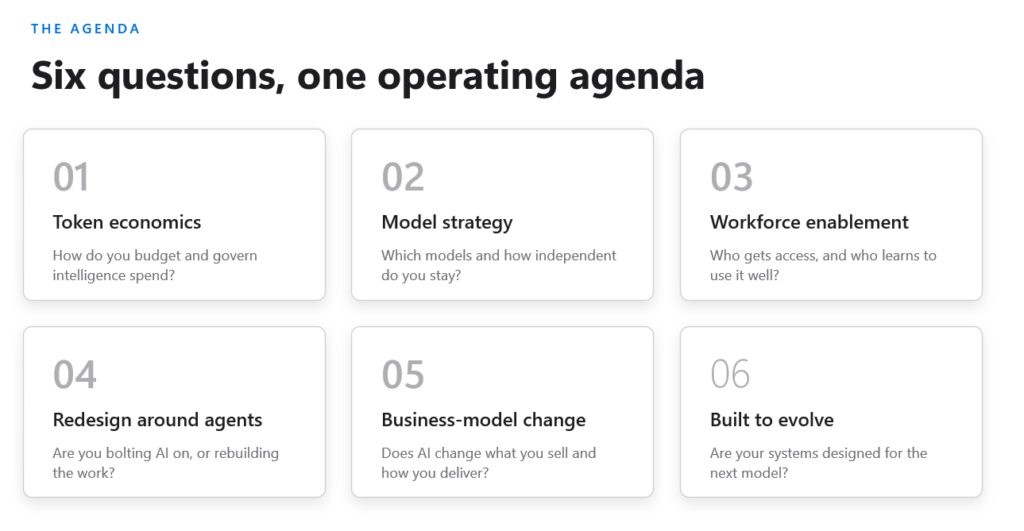
For two years the enterprise size organizational question about AI was simple: will agents actually do the work? That one’s settled, I guess everyone now is familiar at least with the basic capabilities of the agents. The new question is harder and it’s barely about the models at all. It’s about us. Somewhere in the first half of 2026, “if” quietly became “how.” And “how” splits into six questions every organization is now answering, whether they’ve noticed or not:
- What’s your token budget and who controls it? Intelligence is metered now. Treating it as free is the fastest way to blow the economics. Intelligence is metered. Treated as an unlimited resource, it quietly erodes the economics of an AI program. The discipline enterprises need is metering, per-team and per-agent budgets, and the ability to route each task to the least expensive model that meets the bar.
- Which models and how independent do you stay? Cost pressure and sovereignty concerns have turned model choice from a default into a strategic decision. Depending on a single closed provider is now a cost and a risk question at once, especially for institutions with data-residency and operational-control obligations.
- Who gets access and who actually learns to use it well? Access is the easy half. The value comes from fluency: people who work with AI as a reasoning partner rather than a search box. Provisioning licenses faster than skill leaves most of the return on the table.
- Are you bolting AI on, or redesigning the work? The design center is moving from user-centric software to process- and worker-centric systems built around a digital workforce. The leap is not automating a task here and there; it is redesigning workflows and organizational structure around agents that execute end to end.
- Does AI change what you sell and how you’re built? When a small, engineer-heavy team can deliver what once required a department, both unit economics and organizational design come up for review. The question for every institution is whether AI changes its product, its margins, or its headcount logic.
- Are your systems built for the next model, or married to this one? The capability frontier moves monthly. Systems built tightly around today’s model quietly become tomorrow’s technical debt. The winning posture assumes continuous change rather than a one-time integration.
Notice what these have in common: not one is a model question. They’re capital-allocation questions. We spent a decade optimizing human capital. Now we’re learning to budget a second kind, token capital and to redesign the org around a workforce that’s part human, part agent. The public-sector version adds one non-negotiable: all of it has to run inside the mission’s boundaries. In-country. Compliant. Sometimes fully disconnected. Capability you can’t govern isn’t capability – it’s exposure.
Capability that runs inside the mission’s boundaries
For governments and regulated institutions, none of the six answers count unless they hold under strict sovereignty and compliance constraints. This is where Microsoft’s approach is most differentiated.
- Sovereign Cloud, three ways. Microsoft Sovereign Cloud spans a Sovereign Public Cloud, a Sovereign Private Cloud for fully dedicated environments, and national partner clouds. Azure Local extends this to disconnected operations so organizations can run a private cloud with an entirely on-premises control plane, and large multimodal models run fully disconnected through Foundry Local, with an API surface that mirrors the cloud. The same application can move along that spectrum without being rewritten.
- Data residency for productivity AI. In-country processing of Microsoft 365 Copilot interactions began with an initial set of countries and is expanding across Europe and other regulated markets through 2026 like Canada, Germany, Italy, Malaysia, Poland, South Africa, Spain, Sweden, Switzerland, the United Arab Emirates, and the United States among them so that everyday AI assistance respects local data requirements.
- Governance as a default. Encryption at rest, in transit, and in use can block cloud-operator access unless explicitly authorized; a refreshed Sovereign Landing Zone provides a compliant foundation; and consistent policy and compliance visibility spans environments. Agent 365 brings the same rigor to the emerging digital workforce.
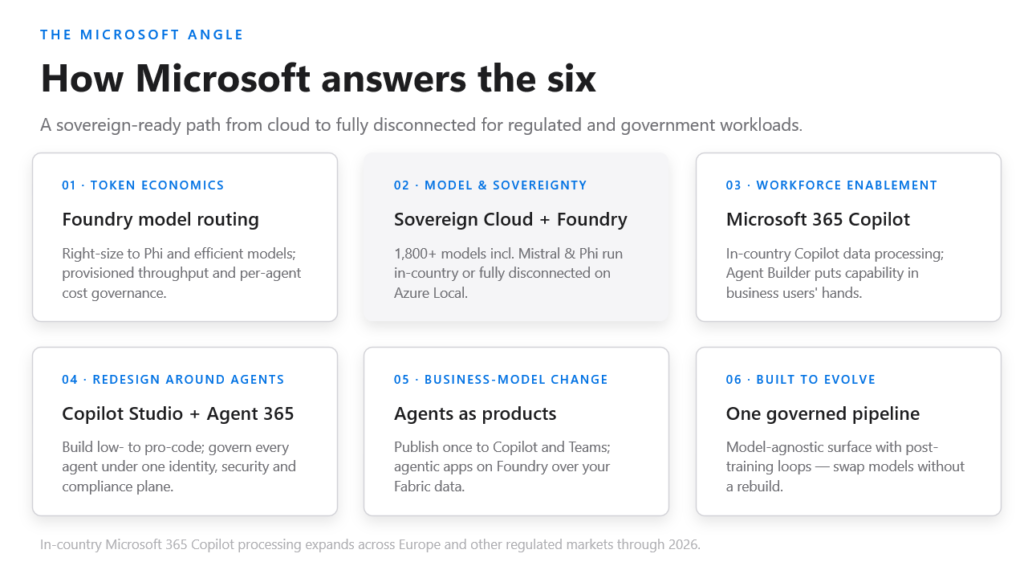
That’s the part I spend my days on. Six hard questions, one platform that carries capability, choice and control together from global cloud to air-gapped. So here’s mine for you: which of the six is your organization answering on purpose? Because most are answering all six by default and that’s the real risk.
Conclusion
The six questions are the operating agenda for the rest of 2026: budget the intelligence, choose the models, build the fluency, redesign the work, rethink the model, and architect for change. They are not solved by assembling six tools. They are solved by a platform that carries capability, choice, and control together and, for the public sector, one that runs wherever the mission requires, from global cloud to fully disconnected.
Call to Action
Where to start with specific organization? I have some recommendations and lets illustrate them if you are Microsoft shop:
- Set a token budget. Turn on cost governance in your favourite tool and route each workload to the right-sized model like Phi and efficient models where they fit.
- Make model choice a layer, not a lock-in. Stand up there as your model-agnostic foundation across frontier and open weights (GPT, Claude, Llama, Mistral, Phi).
- Pick a sovereignty posture per workload. Map each to Sovereign Public Cloud, Sovereign Private Cloud, (if you are Microsoft shop) or fully disconnected Azure Local / Foundry Local and switch on in-country Microsoft 365 Copilot processing.
- Deploy Copilot with a fluency plan. Roll out Microsoft 365 Copilot and Agent Builder, and invest in reasoning-partner skilling not just licenses.
- Govern the agent workforce. Bring every agent under Agent 365 for identity, security and compliance before you scale.
- Build once, publish everywhere. Create agents in Copilot Studio / Foundry, ground them in your data via Microsoft Fabric, and publish through one governed pipeline to Copilot and Teams.
- Engage your team. Validate feature availability for your cloud against the roadmap, and pick one high-value use case to pilot next quarter.